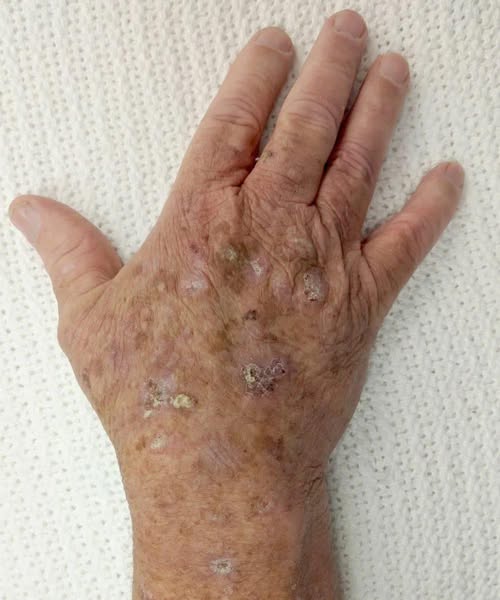
Human skin is a lifelong diary, recording each hour spent under the sun in the form of freckles, lines, and weathered patches that accumulate over decades. Yet amid these normal signs of aging, there are moments when the skin begins to show clues of something far more consequential. What may appear at first as a bit of roughness that does not soften with lotion, a stubborn flake that keeps reappearing, or a dry patch that never fully heals can actually be the body’s quiet signal that ultraviolet radiation has damaged the DNA within its cells. These spots—actinic keratoses—are among the most widespread precancerous lesions on the planet. They develop gradually, usually without pain or dramatic warning signs, slipping into place so subtly that countless people miss them entirely. But beneath their small, unassuming presence lies the earliest visible stage of a process that may progress into squamous cell carcinoma, one of the most common forms of skin cancer. Identifying these early changes, especially for adults over fifty whose skin has weathered decades of sun exposure, is an extraordinarily powerful form of prevention. Not only does early diagnosis stop individual lesions from evolving into cancer, but it also serves as a larger message: every hour exposed to sunlight counts, and the effects accumulate even when we don’t feel them. Understanding the first signs, paying attention to persistent textures or spots, and taking action quickly remain some of the most effective ways of protecting long-term health.
The story of actinic keratosis begins with sunlight—a force that sustains life yet carries hidden costs. Within sunlight are ultraviolet rays, UVA and UVB, which can penetrate deep into the skin and alter the DNA of the cells responsible for forming its protective barrier. Over years or decades of outdoor work, recreation, or unprotected exposure, these tiny injuries build up. Most damaged cells are repaired, but some escape the body’s corrective mechanisms and begin to behave abnormally. Those cells slowly multiply into the rough, persistent patches known as actinic keratoses or solar keratoses. They appear most often on areas that have endured the longest and most consistent sunlight: the face and scalp, especially in balding men; the backs of the hands and forearms; the ears and neck; and the lower lip in people who have spent much of their lives outdoors. Early on, they may not draw the eye, but the fingertips can often feel what the eyes miss—a small, coarse, sandpaper-like patch that remains long after normal dryness should have healed. Over time, the lesion may grow slightly, become flaky or crusted, or form a hardened surface that repeatedly sloughs off and reforms. Their appearance varies widely, from flesh-colored to red or brown, from flat to slightly raised, and from smooth-looking to obviously crusted. Though most cause no pain, they persist, and that persistence is their signature. Left untreated, about ten percent may eventually develop into squamous cell carcinoma—a relatively small percentage at first glance, but given the millions of new actinic keratoses diagnosed each year, the aggregate danger is significant.
Anyone can develop actinic keratoses, yet certain groups face a substantially higher level of risk. People with fair skin—particularly those who burn easily, have light eyes or hair, or have lived much of their lives in sunny regions—are especially prone to developing multiple lesions as they age. Outdoor workers such as lifeguards, farmers, construction workers, and landscapers often show clusters of AKs by midlife, the result of long days under intense sunlight. Those living in regions with powerful UV exposure, such as the American Southwest, Australia, or southern Europe, face risk across all skin types. Individuals with weakened immune systems, including organ transplant recipients and those taking immunosuppressants, develop AKs more frequently and progress to skin cancers more quickly because their bodies struggle to eliminate damaged cells. For many high-risk individuals, dozens of actinic keratoses can accumulate across the scalp, face, and arms as they age, forming part of a larger constellation of sun-induced changes: liver spots, increased wrinkles, thinning skin, and a diminished ability to repair new injuries. At the cellular level, the journey from sun damage to cancer is gradual. UV rays damage DNA, mutations form, and abnormal cells begin multiplying. Early in life, the immune system may effectively remove these cells, but with age—and continued UV exposure—its defenses weaken. When the mutated cells expand deeper into the layers of the skin, breaching the boundary between the epidermis and dermis, the lesion becomes invasive squamous cell carcinoma. That transformation takes months or years, which is why early detection is so vital.
Recognizing the early warning signs can make the difference between an easily treated lesion and a more serious diagnosis. A rough or scaly patch that does not resolve within a month or two, even with moisturizers or exfoliation, is a classic early sign. Areas that appear slightly red or sunburned without healing, crusts that return after peeling, or firm bumps that feel tender when rubbed also merit attention. Often, the lesion’s texture is more telling than its appearance—if a patch catches on your fingernail repeatedly, or if small clusters of dry spots form in sun-exposed areas, an evaluation is warranted. When someone visits a dermatologist for such concerns, the examination is typically simple and straightforward. Using both visual inspection and tools such as dermatoscopes, dermatologists look for structural clues beneath the surface of the skin. If anything appears suspicious, a quick biopsy under local anesthesia confirms whether the spot is an actinic keratosis, a basal cell carcinoma, or another skin condition. Treatments vary based on severity. Cryotherapy—freezing the lesion—remains one of the most effective approaches and is often completed in minutes. Prescription topical creams such as 5-fluorouracil or imiquimod treat areas with multiple lesions by triggering controlled inflammation that clears damaged cells. Photodynamic therapy uses a light-sensitive medication and special light to destroy abnormal tissue with minimal scarring. When lesions are thicker, dermatologists may use curettage or laser therapy to remove them. Early intervention typically leads to complete resolution, often with a single treatment session.
For many people, hearing the term “precancerous” sparks fear or an overwhelming sense of vulnerability. Dermatologists often emphasize that receiving a diagnosis of actinic keratosis should be seen not as a reason for panic, but as a critical opportunity. It is a sign that accumulated sun damage has reached a visible threshold, but also a sign that intervention now can prevent a cancer that might otherwise develop. Many individuals find that an AK diagnosis prompts new habits: consistent sunscreen use, avoiding midday sun, wearing hats or protective clothing, and scheduling routine skin exams. Once someone has had one AK, the likelihood of developing additional lesions increases, making prevention a lifelong priority. Distinguishing actinic keratoses from benign spots such as age spots or seborrheic keratoses can be difficult without training, since these benign lesions also accompany aging. Age spots tend to be smooth and flat, while seborrheic keratoses appear waxy or as though they are “stuck on.” Actinic keratoses, by contrast, have a roughness that stands out with touch. When uncertainty arises, dermatologists recommend erring on the side of caution because early evaluation is simple and can prevent complications. Moreover, some lesions that resemble AKs may already represent early squamous cell carcinoma, especially when they thicken, bleed easily, develop firm edges, or grow rapidly. While SCC is highly treatable when caught early, it can penetrate deeper layers and spread if ignored. Melanoma, although less commonly confused with AKs, carries even greater danger and presents as dark, irregular moles with uneven borders and colors. Regardless of the type, skin cancers share one defining characteristic: they persist beyond the lifespan of normal skin changes.
Around the world, dermatologists have noted a steep rise in cases of actinic keratosis, a trend tied not only to increased sun exposure but also to longer lifespans and improved awareness of skin health. In the United States alone, more than fifty million people receive treatment for AKs each year. Australia, with the highest UV exposure globally, reports that half of adults over forty will develop at least one. Fortunately, medical advances in detection and treatment have improved outcomes dramatically. Full-body skin checks, aided by digital imaging and mole-mapping software, allow clinicians to monitor subtle changes over time. Home-based tools and smartphone apps help individuals track moles or lesions between professional visits. Patient stories underscore the importance of vigilance: a gardener who sought help for a persistent flake on his hand was cured with a few minutes of freezing; another person who waited a year allowed a lesion to progress into early cancer before seeking treatment. Myths surrounding AKs—such as the belief that they are merely dry skin, or that only fair-skinned individuals develop them—continue to delay diagnosis for many. Dermatologists stress that anyone with chronic sun exposure, regardless of skin tone, can develop them, and that pain is not an early sign. Regular skin exams remain the gold standard for early detection, especially for high-risk individuals, and advances in therapies—from combination topical treatments to laser-assisted photodynamic therapy—are making management increasingly effective and cosmetically gentle. In the end, living with sun-damaged skin is not a mark of irresponsibility but a reminder of life lived outdoors. With protective habits, informed vigilance, and regular care, individuals can continue to enjoy sunlight safely. Skin is an organ capable of incredible resilience and self-repair when given the chance. Each mark or patch offers guidance, and listening to those messages ensures that we can keep shaping our story—one that values both the sun and the health of the skin that reflects it.