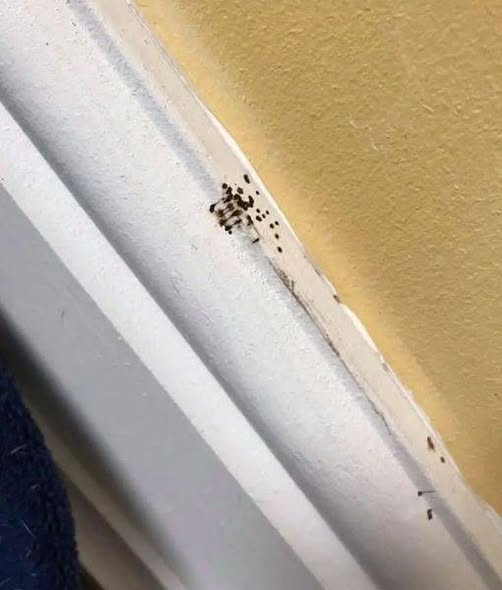
A mother recently turned to Facebook seeking guidance after she noticed something puzzling in her home: a series of black specks scattered along her skirting boards and walls. Unsure what they were, she posted photos on a Mrs. Hinch fan page, hoping for some answers from fellow cleaning enthusiasts.
“Anyone have any idea what this is?” she asked. “These spots just appeared over the last week or so on the skirting board in my dining room. There are also bits on the wallpaper and the floor, which gets mopped every day! It’s not bumpy—it looks like some sort of paint splatter, but it isn’t.” Her post reflected genuine confusion and curiosity, as she struggled to figure out whether the tiny black marks were harmless or a sign of a more serious problem.
The Community Responds: Spider Poo?
Within hours, responses began to pour in from Mrs. Hinch fans and other followers. The most common answer? Spider droppings. Enthusiasts confidently suggested that the mysterious markings were caused by spiders, explaining that it’s quite common this time of year. One user wrote: “It happens a lot this time of year, spiders pooing everywhere. Dettox spray is good for it.” Another shared their personal experience: “It’s spider poo after they’ve eaten flies. I get it on my window sill all the time.” Some users suggested alternative possibilities, like fly droppings, but the majority insisted it was “spider poo for defs.”
The conversation highlighted how many people encounter this odd phenomenon yet are often unsure how to identify or manage it. While spider droppings are small and easy to overlook, they can leave visible black or dark brown marks that cause concern for homeowners.
What Do Experts Say About Spider Droppings?
According to pest-control experts, spiders do indeed produce waste, but it is typically not solid like that of mammals or insects. Instead, spider excrement is thick, liquid, and dark, resembling small ink stains or drips. The appearance can vary depending on the spider’s diet and species, which can make identification tricky for anyone without prior experience.
Spider feces often appear below webs or in corners where spiders feel secure. Since spiders prefer dark, undisturbed areas, droppings may be found in unexpected locations, including skirting boards, walls, windowsills, and even ceilings. Generally, spider droppings are about the size of a pinhead and tend to be monotone in color, ranging from black to brown, gray, or even white in some cases.
Are Spider Droppings Dangerous?
For most households, spider droppings are not considered a major health hazard. Studies indicate that pathogens ingested by spiders do not typically survive in their feces, and there is no evidence that spider droppings transmit disease to humans. Nevertheless, it is wise to handle them cautiously, as with any unknown substance. Experts recommend cleaning up spider droppings using gloves or paper towels, washing hands thoroughly afterward, and disinfecting surfaces when necessary. Fresh droppings are easier to remove, while dried droppings may leave faint yellow stains or require additional scrubbing.
Managing Spider Droppings and Preventing Reoccurrence
Cleaning up spider droppings, while necessary for hygiene, does not remove the spiders themselves. To reduce future sightings of droppings, homeowners need to address the spider population directly. Effective strategies include:
Keeping a consistently tidy home and vacuuming or sweeping corners where spiders may reside.
Removing spider webs as soon as they appear to discourage spiders from returning.
Using over-the-counter spider repellents or sprays specifically designed for indoor use.
Sealing cracks, gaps, and windows to prevent spiders from entering the home.
Calling professional pest-control services if infestations become severe or persistent.
By taking these steps, homeowners can significantly reduce the frequency of droppings while keeping spiders under control.
The Takeaway
Although discovering mysterious black specks around the house can be alarming, in many cases, they are harmless spider droppings. Understanding what spider feces looks like, how it forms, and how to clean it safely helps homeowners maintain a cleaner, healthier living environment. While spiders may leave behind small evidence of their presence, careful management and proper hygiene can ensure that they don’t become a bigger problem.
So the next time you spot tiny black dots on your skirting board or wall, don’t panic—it may just be a little sign that your eight-legged roommate has been busy doing what spiders naturally do.