There are stories that stop a city.
Stories that force people to look up from their routines, their commutes, their busy lives — and face a truth they’ve been avoiding.
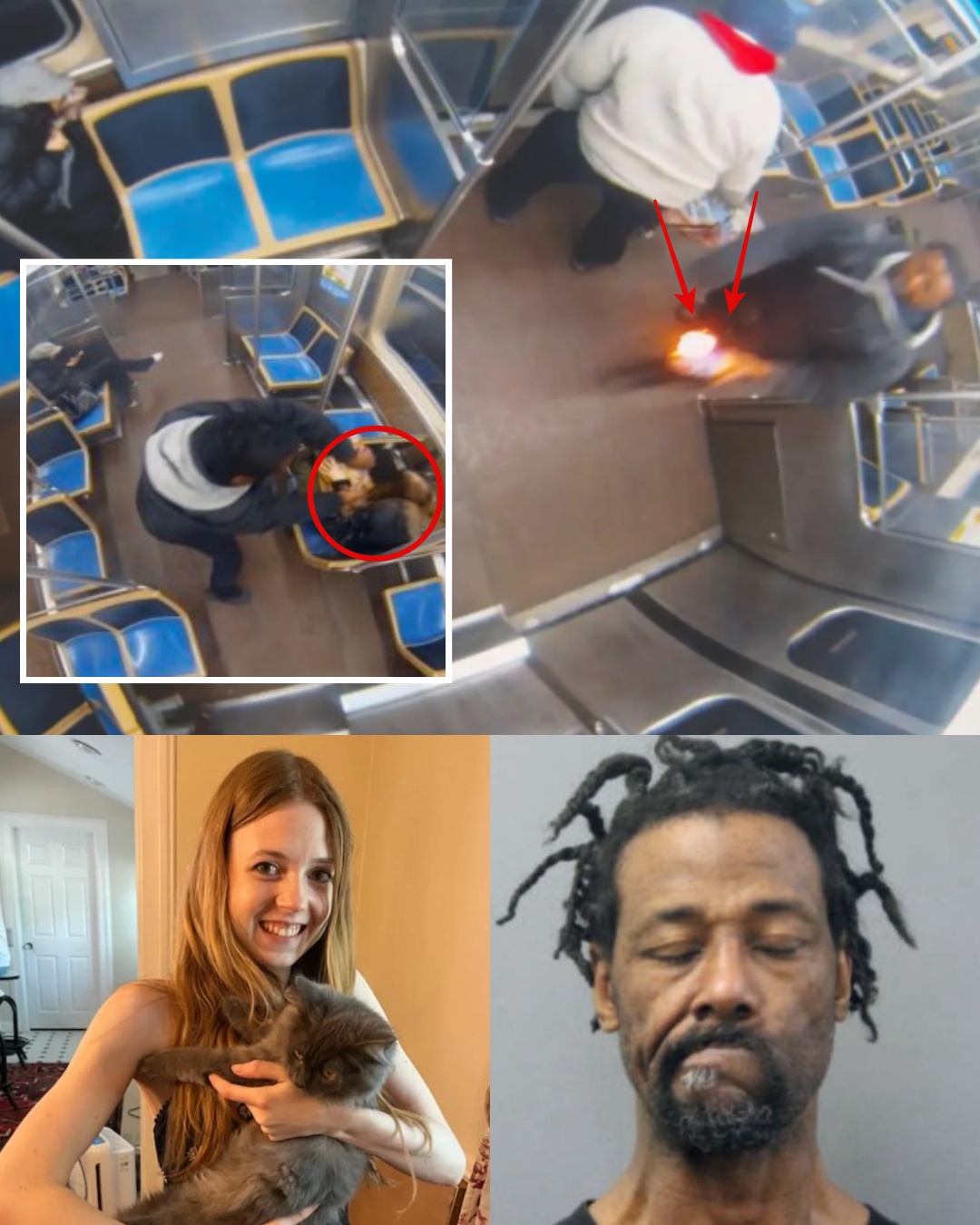
What happened to 26-year-old Bethany MaGee on a Chicago CTA train this week is one of those stories.
A young woman on her way home.
A quiet ride.
A stranger steps forward.
And then — a nightmare.
Bethany was doused in accelerant and set on fire in front of horrified passengers. Flames engulfed her before anyone even understood what was happening. Her screams tore through the train car, echoing off metal walls, leaving witnesses frozen between shock and helplessness.
When the fire was finally extinguished, she was no longer the vibrant girl with bright eyes and a gentle smile — she was a burn victim fighting for her life.
Doctors say her condition remains critical.
Her family is clinging to hope.
And Chicago is left choking on the smoke of a question that has been burning for years:
How did this happen?
How was this allowed to happen?

THE MAN WHO SHOULD NEVER HAVE BEEN FREE
Authorities quickly took a suspect into custody: 50-year-old Lawrence Reed.
A man described by law enforcement as mentally unstable.
A man with a history of violence and unpredictable behavior.
A man who had been arrested at least 72 times.
Seventy-two.
If those numbers make your stomach drop, you’re not alone.
Neighbors, city workers, officers, prosecutors — everyone familiar with cases like this has said the same thing for years:
“This was inevitable.”
And yet, despite the warnings, despite the red flags, despite the spiraling danger,
Reed was still out on the streets. Free to board trains. Free to cross paths with strangers. Free to walk right up to Bethany with a bottle in his hand… and ignite the rest of her life.
Officials are now calling him a “career criminal,” a “repeat offender,” a “known threat.”
But all of those labels came after he destroyed a life.

THE SYSTEM THAT CRACKED — AND WHO FELL THROUGH
In the aftermath of the attack, conversations across Chicago turned furious.
People brought up the SAFE-T Act, the controversial legislation that reshaped pretrial detention and how offenders are handled in Illinois. Critics warned, from the beginning, that loosening constraints on violent offenders would have consequences.
Now those critics are pointing to Bethany.
Not as a political talking point.
Not as a statistic.
But as a human being who paid the price for a system that many say is failing its most vulnerable.
The anger is real.
The fear is real.
The grief… undeniable.
Because this wasn’t a minor oversight.
This wasn’t a single crack in the system.
This was a canyon — wide enough for a dangerous man to walk right through, carrying a bottle of accelerant.

WHO BETHANY IS — AND WHY THIS STORY HURTS EVEN MORE
Before she became a headline, Bethany was simply Bethany.
A 26-year-old woman described by friends as soft-spoken, kindhearted, “the girl who always checked on everyone else.”
She loved her family.
She worked hard.
She helped people whenever she could.
Those who know her say she had a presence that made you want to be better — calmer, more thoughtful, more gentle. The kind of woman who smiled even when she was tired. The kind of daughter who made her parents proud simply by being who she was.
And now, she lies in a hospital bed wrapped in surgical dressings, machines breathing for her, her body fighting the biggest battle it has ever known.
A battle she never should have been forced to fight.
INSIDE THE MOMENT THE TRAIN TURNED INTO A FIRETRAP
Passengers who witnessed the attack describe it in fragments — because trauma rarely lets the mind hold the full picture.
A man pacing.
A bottle in his hand.
A sudden movement.
Then flames.
One woman said she saw the fire before she heard the screams.
Another said the smell — chemical, thick, choking — hit her first.
Someone pulled the emergency handle.
Someone tried to smother the flames with a jacket.
Someone vomited.
Someone fainted.
Chaos in a metal box speeding down the tracks.
When the train finally stopped and emergency personnel forced their way inside, Bethany was collapsed on the floor, her body covered in burns so severe that first responders were forced to work around the clock simply to stabilize her enough to transport.
Doctors later said she survived those first few minutes through sheer will — and timing.
A few seconds more.
A few seconds less.
Everything could have been different.

THE CITY THAT CAN’T KEEP CARRYING THESE STORIES
Chicago is no stranger to violence.
But there’s a difference between violence… and horror.
This wasn’t a robbery.
This wasn’t a fight.
This wasn’t a dispute or an argument.
This was an execution attempt — carried out in public, in broad daylight, on a crowded train filled with people who will never unsee what they saw.
And yet, beneath the shock lies a simmering realization:
Chicago has been collecting tragedies like these for years.
Each one a warning.
Each one ignored.
Each one followed by another.
How many more?
How many more repeat offenders will be released?
How many more families will receive the same late-night call Bethany’s family received?
How many more innocent people will cross paths with someone the system already knew was dangerous?

THE FIGHT FOR HER LIFE
Bethany is now in a specialized burn unit.
She is sedated.
She is in critical condition.
She is undergoing procedures that would break most people mentally and physically.
Her family has asked for prayers.
Doctors have asked for patience.
And the public has asked the question no one in power seems willing to answer:
What will it take for this to stop?
Bethany’s road ahead is measured in surgeries, skin grafts, infections, therapy, and pain most of us cannot imagine. Burn victims often endure years — even decades — of recovery.
And yet, her loved ones say she is a fighter.
A quiet fighter.
A gentle fighter.
But a fighter nonetheless.
“She’s strong,” her mother said.
“She has to be.”

THE PART OF THE STORY THAT WON’T LET GO
You can talk about policy.
You can talk about bail reform.
You can talk about criminal justice and mental health and legislative debates.
But at the center of this story is a 26-year-old woman who boarded a train expecting to arrive safely.
She never even saw the danger coming.
She never even had a chance to run.
And that — more than anything else — is what breaks the heart.
This was preventable.
This was predictable.
This was the kind of tragedy people have been warning about for years.
But warnings only matter if someone listens.

A PRAYER FOR BETHANY — AND A DEMAND FOR ANSWERS
Tonight, people across the country are praying for Bethany MaGee:
Praying for healing.
Praying for strength.
Praying for a miracle.
But prayer alone won’t fix what failed her.
There must be answers.
There must be accountability.
There must be change — real change, not speeches, not statements, not promises that vanish by morning.
Bethany deserved safety.
She deserved protection.
She deserved a future.
Instead, she is lying in a hospital bed fighting for her life… because a repeat offender was allowed to walk free one more time.
And one more time was all it took.