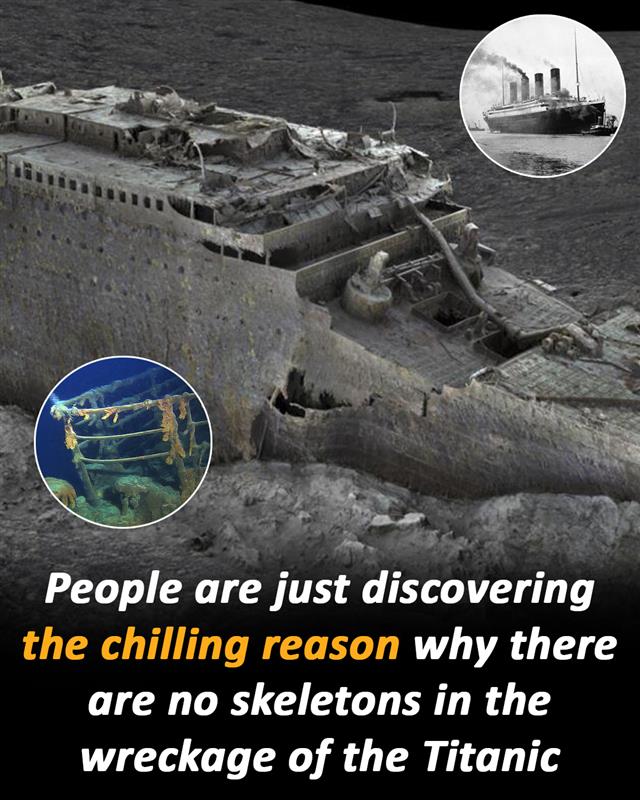
For decades, people have stared at the haunting images of the Titanic resting on the ocean floor, silently wondering the same question: why are there no human remains found inside the wreck? More than 1,500 people lost their lives that night — yet not a single skeleton has ever been recovered from the ship itself.
The answer is far more unsettling than most ever imagined.
When the Titanic sank, many victims either drowned inside the ship or were trapped behind sealed compartments as the vessel split and plunged into the Atlantic. At first, experts expected the cold water to preserve bodies — but the ocean at that depth has a different rule.
The wreck lies nearly 13,000 feet below the surface, where there is almost no light, crushing pressure, and a constant stream of microorganisms that survive by devouring anything organic. Over time, these deep-sea organisms consume human tissue completely, leaving nothing behind. Even bones, which many assume would last, do not. Under immense pressure, and with no calcium-preserving environment, bones eventually dissolve into the surrounding water.
Another factor is the constant movement of currents on the ocean floor. Any remains that may have rested outside the ship were scattered long ago, disappearing into the vastness of the abyss.
What remains today are the clothes, shoes, and objects that once belonged to passengers — eerie reminders that human bodies once filled them. Experts often point to empty shoes placed side by side on the seabed, perfectly shaped, as one of the most heartbreaking signs. The people are gone, but the footprints of their final moments remain.
The Titanic wreck is not just a ship frozen in time — it is a reminder of nature’s power, and the ocean’s unforgiving ability to erase everything except the memories left behind.